
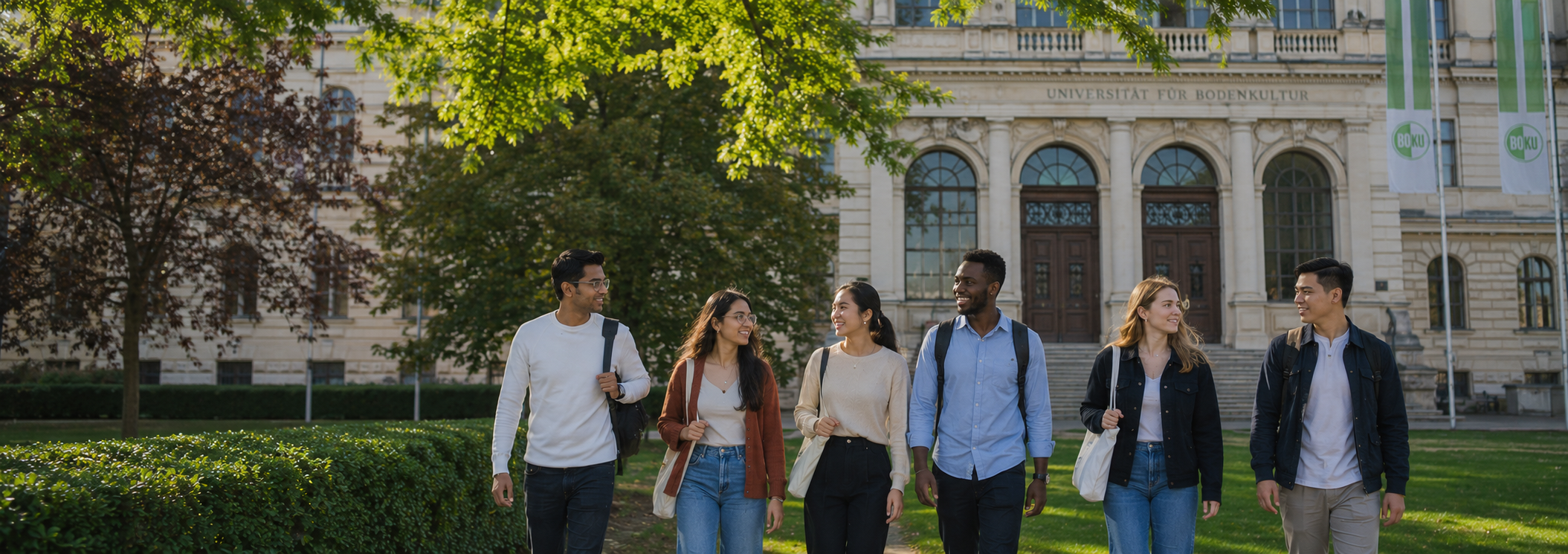
Austrian universities combine deep academic rigour with practical problem-solving, grounded in the Humboldt university model (unity of research and teaching). Students develop independent analytical thinking from the first semester. All curricula are regularly reviewed by AQ Austria. Bologna Process structure: Bachelor (6 semesters / 180 ECTS), Master (4 semesters / 120 ECTS), PhD (6 semesters / 180 ECTS).
Sources: BMBWF; AQ Austria; Bologna Process
Austria's 21 Universities of Applied Sciences (FH) are legally required to maintain active industry partnerships. Every FH programme includes compulsory internship placements (4–6 months). EU Education & Training Monitor 2025 reports 84.7% of recent Austrian VET graduates participated in work-based learning in 2024 — among the highest in Europe. Leading FH institutions include FH Technikum Wien, FH Wien der WKW, IMC Krems and FH CAMPUS 02 Graz.
Sources: EU Education & Training Monitor Austria 2025; FH Austria
Students benefit from a network of globally significant Austrian employers: AVL (world's largest independent automotive R&D firm), Anton Paar, Andritz Group, Red Bull, OMV, Erste Group. Vienna is the third UN headquarter city (after New York and Geneva), hosting IAEA, UNIDO and CTBTO. The WKO connects students with 500,000+ registered businesses. Austria's job-seeker visa framework makes converting an internship into full employment straightforward.
Sources: WKO Austria; AVL; UN Vienna
Austrian universities emphasise critical thinking, cross-cultural communication, teamwork and entrepreneurial mindset. Initiatives include the Vienna Startup Package, FFG Spin-off Fellowship, i²c at WU Vienna, and Startup.University by TU Wien and WU Wien. Austria ranked 3rd in the OECD for STEM-educated adults (32% of tertiary graduates) and #1 in the OECD Talent Attractiveness Index 2023 for attracting highly educated workers.
Sources: FFG; OECD Talent Attractiveness 2023; educationfair.net 2026
Most Bachelor's programmes are taught in German (B2-C1 level required). However, 200+ fully English-taught degree programmes are available, predominantly at Master's and PhD levels, covering computer science, data science, international business, environmental engineering, life sciences and international relations. Key English-medium institutions include CEU, Webster Vienna, Modul University Vienna, and an expanding selection at TU Wien, University of Innsbruck, WU Vienna and JKU Linz.
Sources: studyinaustria.at programme database 2025